|
We know you are busy and may not get around to touching base with our monthly e-bulletin. Why not engage with us by linking up with us and staying informed on what we are doing for industry on LinkedIn The BIC has officially reopened our doors for what will be an interesting 2022. In May this year, Australians will vote for the 47th parliament of Australia. The BIC commenced our election campaign late last year and will continue discussions with all major parties in the coming months. The Omicron wave has delivered much woe around the country and has left many people fearful and covid-weary. Many states/territories are yet to fully bounce-back to the ‘new normal modus operandi’, let alone WA with its continued hard border closure. Waying it all up, we felt that it was best to postpone the planned Bus Industry Summit to June. You can stay up to date with industry events and meetings on our moving people website. Throughout January, our LinkedIn became the AdBlue hub for industry. An update on AdBlue is provided in this bulletin. The BIC has also locked and loaded an interactive key dates calendar for national and international conferences, expos, summits and seminars.
Since 31 Jan, a protest camp (500 metres from BIC’s home in the Parliamentary triangle in Canberra) of ‘anti-vaxxers’ has been calling for the resignation of Australia’s political leaders. Canberra has also seen Invasion Day marches the week prior and celebrated the 60th anniversary of the longest protest in global history – the Aboriginal Tent Embassy. COP26 saw nation-wide protesting on climate change in November last year. There is no doubt that the ‘voter’s campaign’ is in full swing and the closer we get to the federal election, we may continue to see week to week shifts in the topic of the day. We think that Australia’s balance sheet, vaccine mandates, Covid management and lack of skilled workers are going to be at the centre of this federal election. We don’t expect climate The BIC commenced our election campaign late last year meeting with the Deputy PM Barnaby Joyce (Minister for Transport) and Senator Bridget McKenzie (Minister for Regionalisation). The Morrison government will deliver its budget on March 29 – should be an interesting watch – particularly in light of the Omicron wave which has affected much of the country with supply chain issues, staff shortages and low consumer confidence. Morrison’s mid-year economic outlook (delivered in December last year) projected a stronger-than-expected outlook but it is our bet that the average punter out there will be looking at how smartly the borrowed money has been On Jan 28, the BIC submitted a pre-budget funding report to the Australian Treasury. In our pre-budget submission, we provided key funding recommendations to support net zero heavy vehicle safety and the necessary skilled and resilient workforce we need (so many in industry are suffering from lack of access to skilled workers). Our submission also called for funding a tourism campaign to support land transport tourism. BIC’s pre-budget submission to the Australian Treasury can be downloaded from the moving people website.
The latest on AdBlue supply in AustraliaDecember and January seem to have been marked by crisis – the rampaging Omicron outbreak, the collapse of the PCR covid testing system, the scarcity of RATs, floods and storms. Another crisis was the rapidly dwindling supply of AdBlue following an international shortage of refined urea, a key ingredient used in the diesel exhaust fluid. Multiple producers of urea across the globe have either shut down, were undertaking maintenance, or were directed by their governments to focus on domestic markets. While the AdBlue crisis caught the Australian While the NCM was predominantly focussed on ensuring AdBlue supplies along the key trucking routes, the BIC Secretariat got busy securing priority supply for the bus industry from an AdBlue importer. We fast-tracked government clearance and the stock was ready to go – what we couldn’t do however was control the cost of shipping which made the landing cost prohibitive to Australian buyers. Luckily Incitec Pivot Ltd – a domestic manufacturer has been able to ramp up domestic production of AdBlue by around 800 per cent producing over 3 million litres of AdBlue a week – the equivalent of approximately 75 per cent of Australia’s AdBlue needs. Supplies are now being distributed across the country and you should be able to find some near you. Intensive efforts are also underway to stock up retail units of AdBlue (e.g. 1lt, Your best way to stay up to date is via our Linkedin page https://www.linkedin.com/company/bus-industry-confederation
Take this to your federal budget party or bbq in March!Why not spruik your knowledge of the bus and coach industry at your next party! Or take your own message to your local representative ahead of the federal election.
Go to the industry stats page on movingpeople.com.au
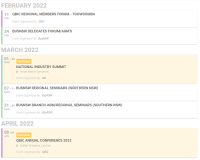
The 2022 National and International Key Dates Calendar is now available at movingpeople.com.au. The calendar is an interactive space allowing users to search and then save events directly into their calendars. A super cool interactive google map tool is also embedded to enable users to ‘get directions’ from one location to the event venue.
|
January 6, 2023
Home We hope you have had a refreshing, safe and happy break over the festive season. 2023 is shaping up to be a big year and we are excited to continue advocating and driving sustainable and realistic change for the bus and coach industry. Registrations are now open for the Bus Industry Summit 2023, early bird accommodation discounts apply so get in quick! We have recently circulated information to our members about the Bus Industry Summit 2023 sponsor opportunities. If you …
December 20, 2022
Home In this Christmas edition of the BIC Bulletin, we showcase highlights from the 2022 BIC National Conference, recognise the fantastic contributors to the auction bus and congratulate the successful bidder and remind members the 2022 BIC National Conference survey is open. We say farewell to one of the long-standing members of the BIC team, announce the BIC Council election results and provide updates on the Infrastructure and Transport Ministers Meeting and the Heavy Vehicle National Law Review. Farewell and …
September 5, 2022
There is no excerpt because this is a protected post.
August 6, 2022
Home In the August edition of the BIC Bulletin, we look at our policy, advocacy and technical outcomes associated with the Jobs and Skills Summit 2022, the Disability Standards for Accessible Public Transport (DASPT) Standards Reform and provide our learnings and insights on the first Connected and Automated Vehicle (CAV) industry briefing by Transport New South Wales (NSW). We also highlight important safety messages from the NSW Office of Transport Safety Investigations (OTSI) Safety Advisory relating to the commissioning …
August 1, 2022
We are halfway through 2022 following years of significant change and impacts to the Australian bus and coach industry. Heavy vehicle regulations, standards and national laws are undergoing their cyclic reviews with three major reforms underway. Excitingly, the Bus Industry Confederation (BIC) has been busy engaging and advocating on behalf of members and the industry with the Australian and state and territory governments and associated agencies on regulatory changes. The three reforms set to impact the Industry are the Disability …